



Does your child breathe through the mouth, snore loudly at night or seem to have a blocked nose all the time? Enlarged adenoids could be one reason. They are common in young children and often shrink with age, but sometimes they cause breathing, sleep or ear problems that need an ENT assessment.
This guide helps parents understand what adenoids are, why they become enlarged, what symptoms to look for, and how treatment decisions are made.
What Are Enlarged Adenoids?
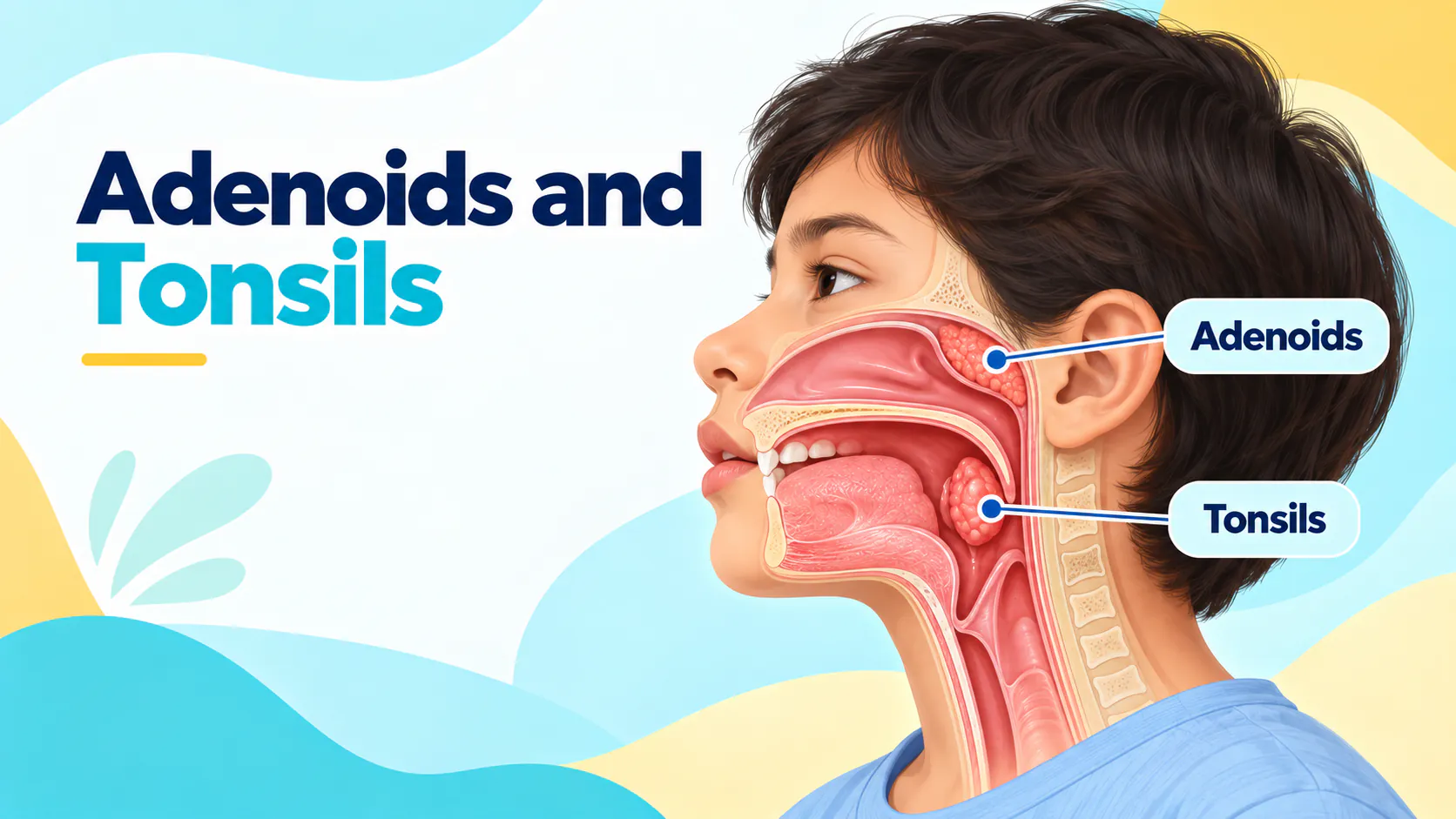
Adenoids are a small patch of soft tissue high up at the back of the nose, above the roof of the mouth. Unlike the tonsils, you cannot see them by looking into your child's mouth.
Adenoids are part of the immune system and help fight germs in early childhood. They tend to be largest in young children and usually shrink as children grow, often becoming very small by the teenage years.
When the adenoids are larger than normal, doctors call this adenoid hypertrophy. Enlarged adenoids can partly block the airway at the back of the nose, and the tubes that connect the nose to the ears.
Why Do Adenoids Become Enlarged?
There is often no single cause. Common reasons include:
- Normal growth: adenoids naturally grow during early childhood
- Repeated infections: frequent colds and throat infections can make them swell
- Allergies: nasal allergy, such as allergic rhinitis, can keep them inflamed
- Irritants: exposure to cigarette smoke and pollution
The size of the adenoids alone does not decide whether there is a problem. What matters most is how much they affect your child's breathing, sleep and hearing.
Symptoms Parents May Notice
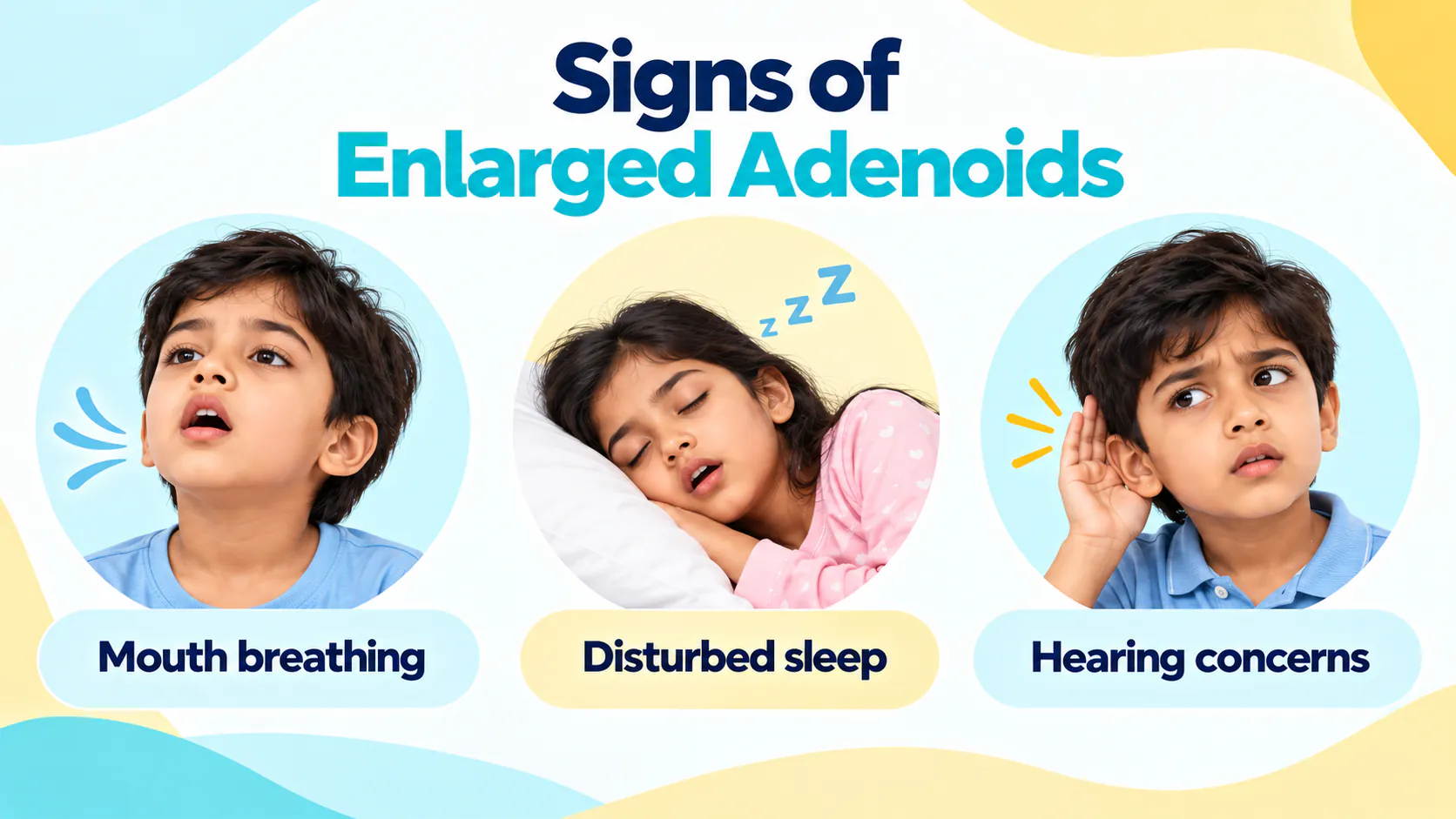
Breathing and Sleep Symptoms
- Breathing through the mouth, especially at night
- A blocked or runny nose most of the time
- A nasal-sounding voice
- Loud, regular snoring
- Pauses in breathing, gasping or choking during sleep, which can be signs of obstructive sleep apnoea
- Restless sleep, daytime tiredness, irritability or poor concentration
- Dry lips and bad breath
Ear and Hearing Symptoms
The adenoids sit close to the openings of the Eustachian tubes, which connect the back of the nose to the middle ear. Enlarged adenoids can block these tubes, leading to:
- Fluid behind the eardrum
- Repeated ear infections
- Muffled hearing. Your child may not respond when called, may turn up the TV, or may have delayed speech
If hearing is a concern, your doctor may recommend a hearing test, such as an audiometry test.
What Does Adenoid Facies Mean?
In some children, long-term mouth breathing may be linked to changes in face shape over time, such as a long, narrow face, an open mouth at rest and crowded teeth. This is sometimes called adenoid facies.
Not every child who breathes through the mouth develops these changes, and enlarged adenoids cannot be diagnosed from a child's appearance or a photograph. If you are concerned, an ENT assessment is the right next step.
How Are Enlarged Adenoids Assessed?
An ENT specialist will ask about your child's breathing, snoring, sleep, ear problems and general health, and will examine the nose, throat and ears.
Because the adenoids cannot be seen through the mouth, the doctor may use a thin, flexible camera passed gently through the nose (nasal endoscopy), or sometimes an X-ray of the side of the neck. If there are ear concerns, hearing tests may be done. If sleep apnoea is suspected, a sleep study may be suggested. Not every child needs every test.
What Are the Treatment Options?
Treatment depends on how much the symptoms affect your child, not just on the size of the adenoids.
Observation and Medical Care
If symptoms are mild, the doctor may suggest watching and waiting, as adenoids often shrink with age. The doctor may also prescribe:
- Steroid nasal sprays to reduce swelling
- Saline nasal drops or sprays to clear mucus
- Treatment for allergies, if they play a part
- Antibiotics only if there is a bacterial infection
Use any medicine only as directed by your child's doctor.
When Adenoidectomy May Be Considered
Surgery to remove the adenoids is called an adenoidectomy. It is done through the mouth under general anaesthesia, with no cuts on the outside, and children often go home the same day.
An ENT specialist may suggest it if your child has:
- Ongoing nasal blockage that affects breathing
- Sleep apnoea, or loud snoring with pauses in breathing
- Repeated ear infections, or long-lasting fluid behind the eardrum with hearing loss
- Repeated sinus infections
Sometimes the tonsils are removed at the same time. Recovery usually takes a few days to a week. Like any surgery, it has risks such as bleeding and anaesthesia-related risks, so the decision is made together with your ENT specialist.
When Should You Seek ENT Care?
Get emergency care right away if your child is struggling to breathe, has bluish lips, or is very drowsy and hard to wake.
See an ENT specialist if your child has:
- Mouth breathing or a blocked nose lasting several weeks
- Loud, regular snoring or pauses in breathing during sleep
- Poor sleep, daytime tiredness, or behaviour or school concerns
- Repeated ear infections, fluid in the ears, hearing concerns or speech delay
- Repeated sinus infections
For general health concerns, you can also start with your child's paediatrician. To learn more about tonsil problems, read our guide on tonsillitis.

