



Has your doctor suggested a hearing test? An audiometry test is a simple, painless test that measures how well you hear. It helps find out whether you have hearing loss, how much, and which part of the ear may be involved.
This guide explains what an audiometry test is, when you might need one, how to prepare, what happens during the test and what your results can mean.
What Is an Audiometry Test?
An audiometry test, also called an audiometry examination, measures the softest sounds you can hear at different pitches. It may also check how clearly you can hear and understand speech.
The test is usually done by an audiologist in a quiet, soundproof room or booth. Your results are shown on a chart called an audiogram, which gives a picture of your hearing in each ear.
When Might You Need an Audiometry Test?

Your doctor may recommend an audiometry test if you have:
- Difficulty following conversations, or often ask people to repeat themselves
- A need to keep the TV or phone volume high
- Ringing or buzzing in the ears (tinnitus)
- Repeated ear infections or fluid behind the eardrum
- Dizziness or balance problems along with hearing changes
- Regular exposure to loud noise at work, or medicines that can affect hearing
- A need for hearing aids to be fitted or adjusted
In children, testing may be advised for speech or language delay, not responding to sounds, concerns raised at school, or ear problems linked to enlarged adenoids.
Sudden hearing loss is an emergency. Get medical help the same day rather than waiting for a routine test.
How to Prepare for the Test
- Follow any instructions from your clinic
- You do not usually need to fast; eat and drink as normal
- Avoid very loud noise, such as concerts or loud headphones, the day before, as it can temporarily affect hearing
- Tell the clinic if you have a cold, ear pain, discharge or a blocked ear, as these can affect results. Earwax may need to be removed first.
- Bring any previous hearing reports and a list of your medicines
- Bring your hearing aids if you use them
- Don't clean inside your ears with cotton buds before the test
How Does an Audiometry Test Work?
Pure Tone Audiometry
Pure tone audiometry is the main part of most hearing tests. You wear headphones and hear a series of beeps at different pitches (from low to high) and different volumes. You press a button or raise your hand each time you hear a sound, even if it is very faint.
Each ear is tested separately. The softest sound you can hear at each pitch is called your hearing threshold and is measured in decibels (dB).
Air and Bone Conduction
- Air conduction: sounds are played through headphones. This tests the whole hearing pathway, from the outer ear to the inner ear.
- Bone conduction: a small device is placed behind your ear. It sends gentle vibrations through the bone directly to the inner ear, bypassing the outer and middle ear.
Comparing the two results helps show where a problem lies. A difference between them suggests a problem in the outer or middle ear. Similar results with both suggest the inner ear or hearing nerve is involved. Sometimes a soft noise is played in the other ear so that only one ear is tested at a time.
Speech Testing and Other Hearing Tests
- Speech audiometry: you listen to words at different volumes and repeat them. This shows how well you hear and understand speech.
- Tympanometry: a small probe in the ear checks how the eardrum moves and whether there is fluid behind it.
Babies and young children cannot do the same response-based test as adults. Newborns are usually tested with OAE (otoacoustic emissions), where a small probe measures the ear's response to sound, or ABR (auditory brainstem response), where small sensors on the head record the brain's response, often while the baby sleeps. Older toddlers may be tested through play-based methods.
What Do Audiometry Results Mean?
Reading the Audiogram
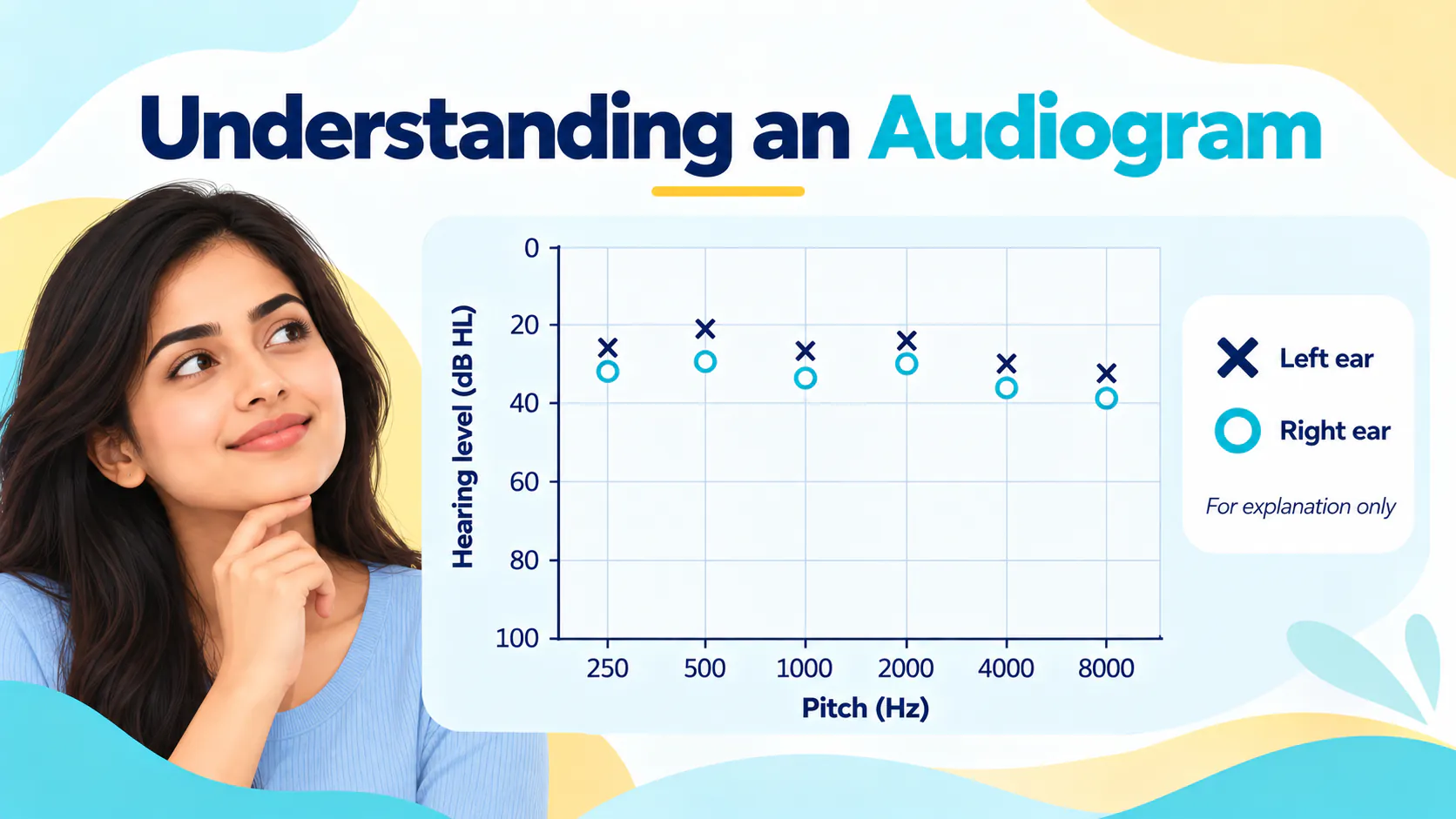
On an audiogram:
- The horizontal line shows pitch, from low on the left to high on the right
- The vertical line shows loudness. Softer sounds are at the top and louder sounds are at the bottom
- Marks show each ear's results, often circles for the right ear and crosses for the left
The closer your marks are to the top of the chart, the better your hearing. Here is a general idea of hearing levels, although different guidelines use slightly different ranges:
- Up to 25 dB: usually within the normal range for adults
- 26 to 40 dB: mild hearing loss
- 41 to 55 dB: moderate hearing loss
- 56 to 70 dB: moderately severe hearing loss
- 71 to 90 dB: severe hearing loss
- Over 90 dB: profound hearing loss
The audiogram also shows patterns. For example, a dip at high pitches can be linked to noise exposure or ageing, and a gap between air and bone results can point to a middle ear problem.
Why Results Need Professional Interpretation
A single number cannot diagnose hearing loss. Your audiologist or ENT specialist looks at the full pattern across different pitches, compares both ears and both test types, and considers your speech results and symptoms. They will explain what your results mean for you.
What Happens After the Test?
If your results are normal, you usually need no further action, but get tested again if symptoms appear or change.
If the test shows hearing loss, an ENT specialist will look for the cause. You may need further tests in some cases, such as when hearing loss affects only one ear. Treatment depends on the cause and may include:
- Removing earwax
- Treating an ear infection or fluid behind the eardrum
- Hearing aids
- Surgery for certain ear conditions
- Advice on protecting your hearing, with regular follow-up tests

